Complete Guide to the Portuguese Way of Saint James – Stages, Distances and Planning
The Portuguese Way of Saint James (Camino Portugués) is one of the most important historic routes of the Camino de Santiago and currently the fastest-growing route in the entire Jacobean network. Traditionally used by pilgrims from Portugal and southern Europe, it has become one of the most international, complete, and well-travelled routes today.
The Portuguese Way is structured into two main official variants:
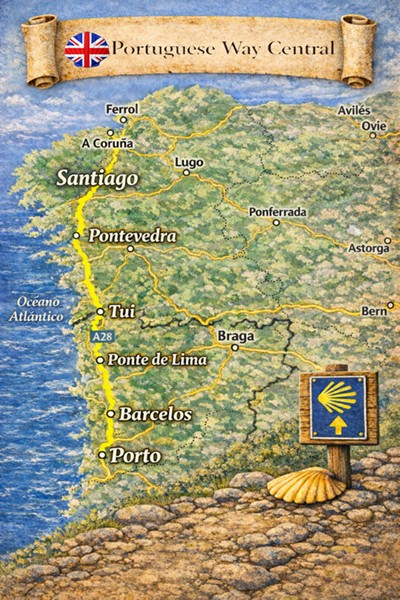
- Central Portuguese Way: the traditional historic inland route
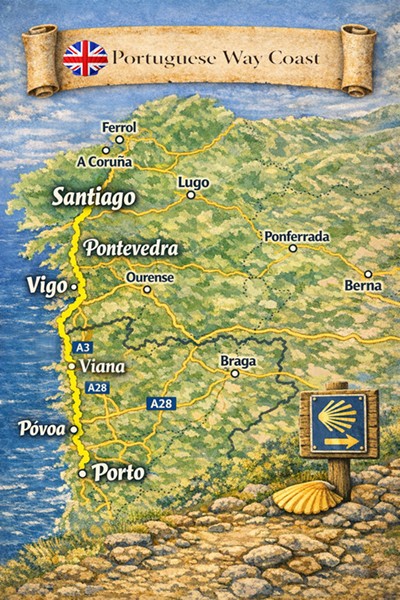
- Portuguese Coastal Way: the Atlantic coastal route with the highest pilgrim growth in recent years
Both routes start from Porto, offer very different experiences in terms of landscape and culture, and are perfectly signposted, organized, and prepared for the modern pilgrim. Both variants converge in Redondela and share the final section to Santiago de Compostela.
Peregrino.online provides the complete guide for each route, with detailed stages, maps, profiles, services, planning, and practical resources. Although some pilgrims choose to start further south, in Lisbon or other towns, the Peregrino Online guides begin in Porto, which is also the point where the Portuguese Way splits into its two variants.
What is the Portuguese Way?
The Portuguese Way (Camino Portugués) is the Jacobean route connecting Portugal with Santiago de Compostela, crossing northern Portugal and Galicia to reach the spiritual capital of the Camino de Santiago.
It is a route characterized by:
- High-quality infrastructure and signposting throughout
- Great landscape diversity: Atlantic coast, river valleys, historic cities
- Strong Portuguese and Galician cultural identity
- Excellent logistical accessibility from across Europe
- Abundant services along the entire route
- Choice between inland (Central) or coastal (Coastal Way) variant
It is an ideal route for both first-time pilgrims and experienced walkers, offering an optimal balance between physical challenge, natural beauty, historical heritage, and organizational comfort.
Central Portuguese Way vs Portuguese Coastal Way – Which one should you choose?
The first question any pilgrim planning the Portuguese Way asks is: should I walk the Central route or the Coastal route? Both are official routes, both start from Porto, and both allow you to obtain the Compostela. The choice depends on the type of experience you are looking for.
Central Portuguese Way
The Central Portuguese Way is the traditional historic route. It runs inland through cities and towns such as Porto, Barcelos, Ponte de Lima, Tui, Redondela, Pontevedra and Padrón.
Features:
- Inland route through Portugal and Galicia
- Greater historical and monumental heritage
- Varied rural and urban environments
- More classic route with a stronger Jacobean tradition
- Greater presence of Portuguese and Spanish pilgrims
- Total distance from Porto: ~237 km
Portuguese Coastal Way
The Portuguese Coastal Way follows the Atlantic coastline, combining coastal paths, beaches, cliffs, and maritime towns such as Porto, Vila do Conde, Viana do Castelo, A Guarda, Baiona and Vigo.
Features:
- Coastal route with views of the Atlantic Ocean
- Outstanding scenic and visual appeal
- More international route with a greater presence of European pilgrims
- Includes a ferry crossing from Caminha to A Pasaxe
- More open, natural, and spectacular experience
- Total distance from Porto: ~264 km
| Central Portuguese Way | Portuguese Coastal Way | |
|---|---|---|
| Distance from Porto | ~237 km | ~264 km |
| Number of stages | 11 | 11 |
| Landscape type | Inland, rural, historic | Coastal, Atlantic, natural |
| Difficulty | Medium | Medium |
| Pilgrim profile | Traditional, cultural | International, scenic |
| Ferry crossing | No | Yes (Caminha – A Pasaxe) |
| Right to Compostela | Yes | Yes |
Where does the Portuguese Way start? Main starting points
Although the Peregrino Online guides begin in Porto, the Portuguese Way can be started from several points. The further south you start, the more kilometres you will walk and the more days you will need.
| Starting point | Distance to Santiago | Estimated days | Notes |
|---|---|---|---|
| Lisbon | ~620 km | 25–28 days | Southernmost start, complete experience |
| Porto | ~237–264 km | 11–13 days | Most common starting point |
| Tui | ~114 km | 5–6 days | First Spanish town, very popular |
| Redondela | ~82 km | 4–5 days | Where both variants converge |
Portuguese Way from Porto
Porto is the most popular and recommended starting point for the Portuguese Way. The city offers excellent flight connections from across Europe, including direct flights from major Spanish, German, Italian, British, and American cities. From Porto you can choose between the Central route (inland) or the Coastal Way (along the Atlantic coast), as both variants start here.
Portuguese Camino from Porto to Santiago – how long does it take?
Walking the Portuguese Way from Porto takes between 11 and 13 days at a comfortable pace, covering around 237 km (Central) or 264 km (Coastal). Most pilgrims complete it in 12 days. This makes the Portuguese Way from Porto one of the most accessible options for those who want the full Camino experience without the 30+ days required by the French Way.
Portuguese Way starting from Tui
Tui is the entry point into Spain on the Central Portuguese Way and the most popular starting point on the entire route. From Tui to Santiago is approximately 114 kilometres — enough to obtain the Compostela and comfortably spread across 5 stages. It is the equivalent of what Sarria represents on the French Way: the point where the greatest concentration of pilgrims begins, looking to complete the minimum required distance.
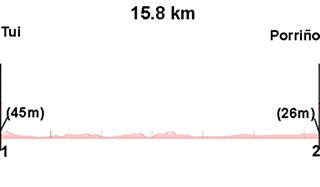
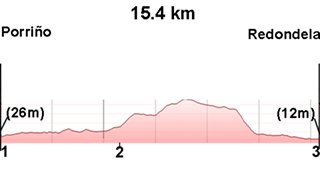
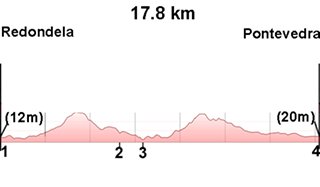
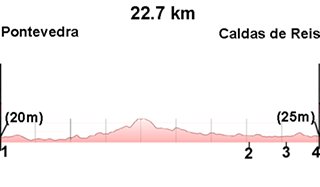
The stages from Tui are: Tui–O Porriño (15.8 km), O Porriño–Redondela (15.4 km), Redondela–Pontevedra (17.8 km), Pontevedra–Caldas de Reis (22.7 km) and Caldas de Reis–Padrón–Santiago (41.9 km, usually split over two days).
The easiest way to reach Tui is to fly into Porto or Vigo and take a bus or taxi. From Vigo there is direct transport in under 30 minutes.
Portuguese Way from Lisbon
Some pilgrims choose to begin the Portuguese Way from Lisbon, adding around 620 kilometres to Santiago de Compostela. This option requires between 25 and 28 days and offers the most complete experience of the Portuguese Way, crossing all of Portugal from south to north. It is a minority choice but growing in popularity, especially among pilgrims seeking a more authentic, less crowded experience.
Stages of the Portuguese Way
The Portuguese Way is structured into two main variants — Central Portuguese Way and Portuguese Coastal Way — which converge in Redondela and continue as a single route to Santiago de Compostela.
The full route is usually organized into 11 stages, easily meeting the minimum distance requirement to obtain the Compostela.
The following are the real accumulated distances for the main sections:
- Porto – Tui (Central Portuguese Way):
The route from Porto to Tui inland through Portugal totals 123.9 km, corresponding to the complete itinerary through Portugal until entering Galicia. - Tui – Santiago de Compostela (Galician section):
From Tui to Santiago de Compostela, including the Galician stages and the shared section Redondela–Santiago, the total distance is 113.6 km. This section meets the minimum distance requirement for the Compostela. - Porto – Caminha (Portuguese Coastal Way):
The coastal route from Porto to Caminha totals 108.0 km, passing through maritime towns and Atlantic coastal sections. - A Pasaxe – Santiago de Compostela (coastal route + shared section):
From A Pasaxe, after the ferry crossing from Caminha, and continuing to Santiago de Compostela, the total accumulated distance is 156.4 km.
| Stage | Section | Approx. distance |
|---|---|---|
| Central Portuguese Way (from Porto) | ||
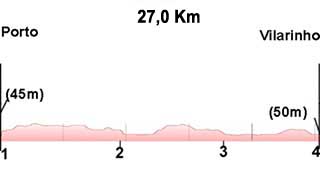
| 1 | Porto – Vilarinho | 27.0 km |
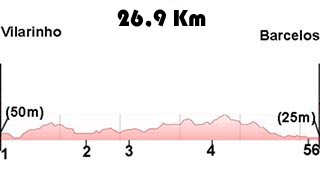
| 2 | Vilarinho – Barcelos | 26.9 km |
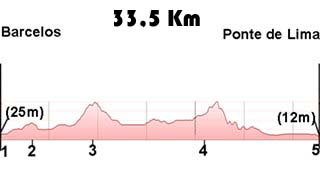
| 3 | Barcelos – Ponte de Lima | 33.5 km |
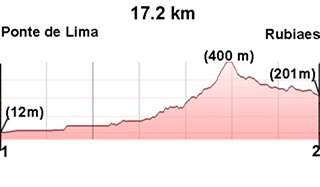
| 4 | Ponte de Lima – Rubiaes | 17.2 km |
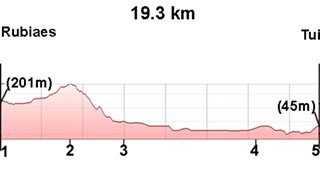
| 5 | Rubiaes – Tui | 19.3 km |
| 6 | Tui – O Porriño | 15.8 km |
| 7 | O Porriño – Redondela | 15.4 km |
| Portuguese Coastal Way (from Porto) | ||
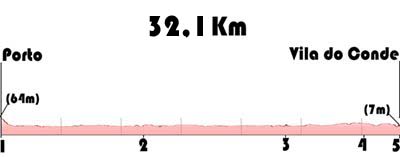
| 1 | Porto – Vila do Conde | 32.1 km |
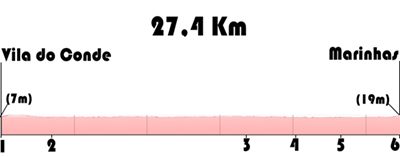
| 2 | Vila do Conde – Marinhas | 27.4 km |
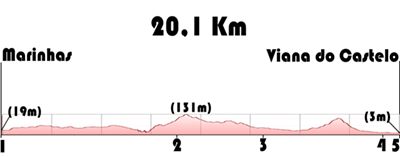
| 3 | Marinhas – Viana do Castelo | 20.1 km |
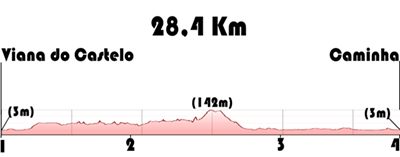
| 4 | Viana do Castelo – Caminha | 28.4 km |
| — | Ferry Caminha – A Pasaxe | — |
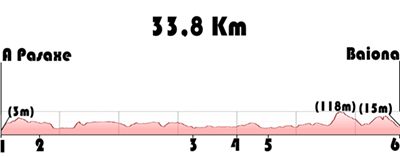
| 5 | A Pasaxe – Baiona | 33.8 km |
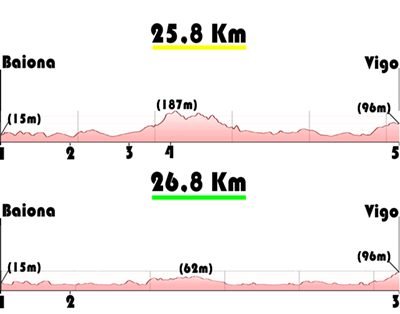
| 6 | Baiona – Vigo | 25.8 km |
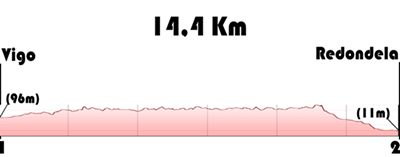
| 7 | Vigo – Redondela | 14.4 km |
| Shared Section Central–Coastal (Redondela → Santiago) | ||
| 8 | Redondela – Pontevedra | 17.8 km |
| 9 | Pontevedra – Caldas de Reis | 22.7 km |
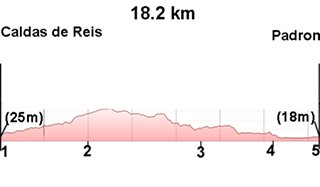
| 10 | Caldas de Reis – Padrón | 18.2 km |
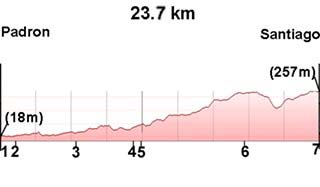
| 11 | Padrón – Santiago de Compostela | 23.7 km |
This structure corresponds to the real planning of the Portuguese Way: independent routes from Porto inland and along the coast, converging in Redondela and continuing as a unified final section to Santiago de Compostela.
How long is the Portuguese Way?
The distance of the Portuguese Way varies depending on the variant and starting point:
- Full Central Portuguese Way from Porto: ~237 km
- Full Portuguese Coastal Way from Porto: ~264 km
- From Tui to Santiago: ~114 km (sufficient for the Compostela)
- From Lisbon to Santiago: ~620 km
In all cases the Portuguese Way comfortably exceeds the minimum 100 km required to obtain the Compostela on foot, or 200 km by bicycle.
Frequently asked questions about the Portuguese Way
Where does the Portuguese Way start?
The most common starting point is Porto, where the route also splits into its two variants: Central and Coastal. You can also start in Lisbon (~620 km), Tui (~114 km), or any intermediate town along the way.
How long does it take to walk the Portuguese Way?
From Porto, the typical duration is 11 to 13 days. From Tui, 5 to 6 days. From Lisbon, between 25 and 28 days. The Portuguese Way is also popular as a 5-day camino when starting from Tui or Redondela.
Is the Portuguese Way difficult?
It is a route of medium difficulty, more accessible than the French Way. There are no demanding mountain stages and the infrastructure is excellent throughout. It is ideal for first-time pilgrims or those looking for a more relaxed experience.
Can you walk the Portuguese Coastal Way all the way?
Yes. The Portuguese Coastal Way is a fully independent route from Porto to Redondela, after which it joins the shared section to Santiago. It is completely walkable and one of the most scenic options on the entire Camino de Santiago network.
How many stages does the Portuguese Way have?
The Portuguese Way is typically divided into 11 stages from Porto to Santiago — 7 stages on the Portuguese section (either Central or Coastal) plus 4 shared stages from Redondela to Santiago. Starting from Tui, the route covers 5 stages.
What is the best time of year to walk the Portuguese Way?
Spring (April–June) and autumn (September–October) are the best times. September is the month with the highest number of pilgrims. Winter is possible but some hostels close. Summer can be hot, especially in the Portuguese interior.
What is the difference between the Central and the Coastal route?
The Central route is the traditional historic way, inland, with more historical heritage. The Coastal Way follows the Atlantic coast and is visually more spectacular. Both have a similar total distance from Porto and share the same final stages in Galicia. The choice depends on whether you prefer inland or coastal scenery.
Can you do the Portuguese Way by bike?
Yes. Both the Central and Coastal variants are suitable for cycling along most of the route. To obtain the Compostela by bike, the minimum is 200 km (instead of 100 km on foot), so Porto would be the closest valid starting point. The Peregrino Online app includes the Bicigrino guide with specific information for cycling pilgrims.
What credential do I need for the Portuguese Way?
The same as for any Camino de Santiago route: the Pilgrim's Credential (Credencial del Peregrino), which can be obtained at Friends of the Camino associations, at the pilgrim offices in Tui or Porto, or at many hostels along the route. You need to collect stamps (at hostels, churches, cafés) to be able to request the Compostela upon arriving in Santiago.
Portuguese Way Statistics
The Portuguese Way has been the Camino de Santiago route with the greatest growth in pilgrim numbers in recent years, consolidating itself as one of the main axes of the modern Jacobean system.
Growth in pilgrim numbers
- Central Portuguese Way:
- 2019: 72,000 pilgrims
- 2025: 100,000 pilgrims
- Portuguese Coastal Way:
- 2019: 22,000 pilgrims
- 2025: 90,000 pilgrims
Adding both routes, the Portuguese Way has grown from 94,000 pilgrims in 2019 to 190,000 pilgrims in 2025, an increase of over 100% in just six years. The Portuguese Coastal Way has been the fastest-growing route proportionally across the entire Camino de Santiago network.
Main starting points
Central Portuguese Way (2025)
- Tui: 41,000 pilgrims
- Porto: 26,000 pilgrims
- Valença do Minho: 18,000 pilgrims
These three points account for approximately 85% of all pilgrims on the Central Portuguese Way.
Portuguese Coastal Way (2025)
- Porto: 25,000 pilgrims
- Vigo: 18,000 pilgrims
- Baiona: 10,000 pilgrims
Pilgrim nationalities
The most frequent nationalities on the Portuguese Way are:
- Spain
- Portugal
- United States
- Italy
- Germany
Differences between routes
- Central Portuguese Way: Spaniards (38%), Portuguese (12%)
- Portuguese Coastal Way: Greater presence of Italians, Germans, and Poles. Polish pilgrims, for example, number 4,000 on the Coastal Way vs 1,500 on the Central route.
Months with the highest number of pilgrims
- September (highest influx)
- May, June, July and August
Ways of completing the route
- On foot: main modality
- By bicycle: 4% of pilgrims
- On horseback: 248 people
- In a wheelchair: 65 people
Gender distribution (2025)
- Women: 58%
- Men: 42%
Who is the Portuguese Way ideal for?
- First-time pilgrims looking for a well-organized, accessible route
- People with limited time (the Portuguese Way from Tui can be done in 5 days)
- Walkers who value infrastructure, signposting, and services
- Pilgrims seeking landscape variety: coast or inland
- International travellers flying into Porto or Vigo
- People who want to combine nature, culture, and Portuguese cuisine
- App users and digital planners
Advantages of the Portuguese Way over other routes
- High-quality signposting throughout the entire route
- Complete infrastructure: hostels, restaurants, medical services
- Choice between inland (Central) or coastal (Coastal Way) variant
- Landscape diversity: Atlantic coast, river valleys, historic cities
- Excellent logistical accessibility from Porto and Vigo
- Large network of hostels along the entire route
- The Coastal Way is the fastest-growing route in the entire Camino de Santiago network
- Adaptable to different physical profiles and time availability
The Portuguese Way within the Camino de Santiago
The Portuguese Way is today one of the structural routes of the Jacobean system. It is not an alternative or secondary route: it is the second main axis of the modern Camino de Santiago, only behind the French Way in total pilgrim numbers, and the first in terms of growth rate.
Its expansion in recent years — especially the boom in the Portuguese Coastal Way — makes it one of the strongest, most dynamic, and most complete routes in the Jacobean ecosystem.
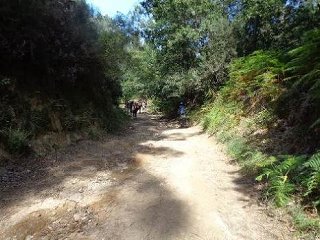
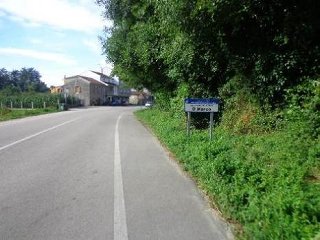
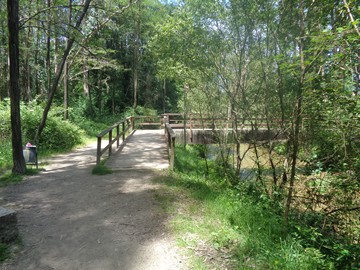
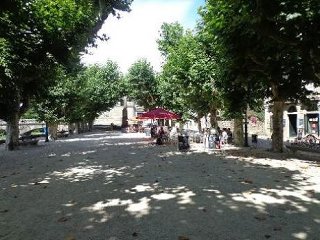
The Portuguese Way in images